

How does geography relate to poverty?
Data for regional and concentrated poverty
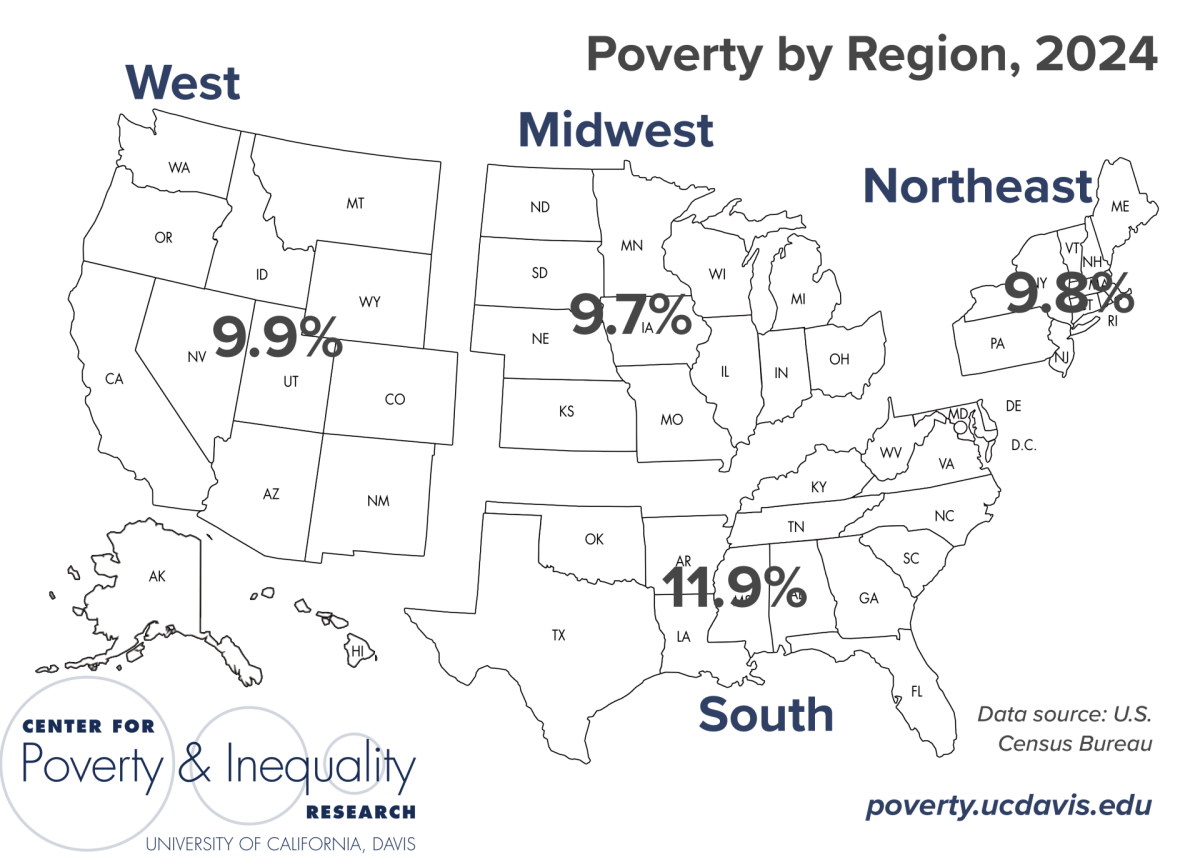
In 2024, poverty rates across the four Census geographic regions ranged from 9.7 percent in the Midwest, 9.8 percent in the Northeast, 9.9 percent in the West and 11.9 percent in the South. Because of the South’s largest share of the total U.S. population, it has the largest number of people who live in poverty compared to any other region.
The poverty rate also varies between metropolitan and non-metropolitan areas. In metropolitan areas, the poverty rate in 2024 was 10.2 percent, compared to 13.7 percent for non-metropolitan areas. However, because many more people live in metro areas, these areas were home to nearly five times as many of the total poor compared to non-metropolitan areas.
While the most recent Census report on poverty showed improvements in a number of areas, those who live in rural or other non-metropolitan areas did not fare as well. While the poverty rate went down in metropolitan areas by 0.5 percentage points from 2023-2024, poverty outside of metropolitan areas actually increased slightly, from 13.5 to 13.7 percent.
What is concentrated poverty?
The U.S. Census Bureau considers census tracts with poverty rates above 20 percent to be “poverty areas.” Some government programs use this definition of concentrated poverty to target resources to low-income communities. Researchers have argued that concentrated poverty may in part result from living geographically far from jobs.
Poverty is not evenly distributed across neighborhoods and every state has neighborhoods with higher than average poverty rates. Five-year estimates from the American Community Survey 2015-2019 data show that 21.1% of all people in the United States live inside poverty areas.
Updated 12/22/2025
For more information:
U.S. Census Bureau. 2025. Poverty in the United States: 2024. Current Population Reports (P60-287). Washington, DC: U.S. Census Bureau.
U.S. Census Bureau. 2025. Income in the United States: 2024. Current Population Reports (P60-286). Washington, DC: U.S. Census Bureau.