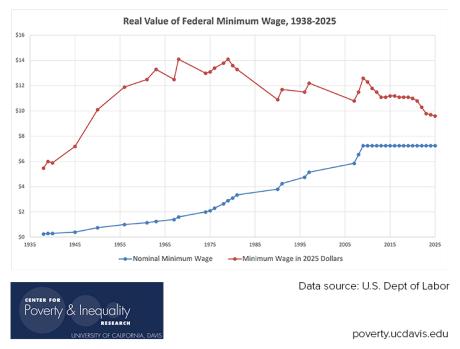
Since it was first instituted in 1938, the federal minimum wage has established a floor for wages. While not every worker is eligible, it provides a minimum of earnings for the lowest-paid workers.
What are full-time annual earnings at the current minimum wage?
A minimum wage is the lowest wage that employers may legally pay
to workers. The first minimum wage law was enacted in 1894 in New
Zealand.
With the passage of The
Fair Labor Standards Act of 1938 (FLSA), the U.S.
minimum wage was initially set at $0.25 per hour for covered
workers. Since then, it has been raised 22 separate
times–most recently, in July 2009, to $7.25 an hour.
FSLA provided a number of federal protections for the first time
including
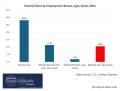
The Census Bureau reports poverty rates by work experience for people ages 18 to 64. In 2024, the overall poverty rate for people ages 18 to 64 was 9.6% (lower than the rate of 10.6% for all persons).
The poverty rates by work experience for that age group ranged from 1.8% to 28.2%.
The “working poor” are people who spend 27 weeks or more in a
year in the labor force either working or looking for work but
whose incomes fall below the poverty
level. According to the U.S. Bureau of Labor Statistics,
6.4 million people who spent at least 27 weeks in the labor force
were poor in 2022 (the most recent year in which such figures
were published). The working-poor rate—the proportion of the
working poor among all people in the labor force for at least 27
weeks—was 4.0 percent in 2022.
In 2024, about 82,000 U.S. workers age 16 and over earned exactly
the prevailing federal minimum wage of $7.25 per hour. Another
760,000 had wages below the federal minimum. Together these
workers make up 1.0% of all hourly paid workers.
The proportion of hourly workers paid minimum wage or less is far
below the level of 13% in 1979 when data was first collected on a
regular basis and somewhat lower than recent years.
What were the characteristics of hourly workers paid at or below
minimum wage in 2024?